Why the Hywel Dda University Health Board partnership is leading NHS social value
15 Oct 2026 · @Tiia
Hywel Dda University Health Board is moving away from managing social value contract by contract or relying on proxies. Instead, it is creating one coordinated partnership system across its supply chain for ensure high quality social value plans, instant delivery and verified impact reporting on results.
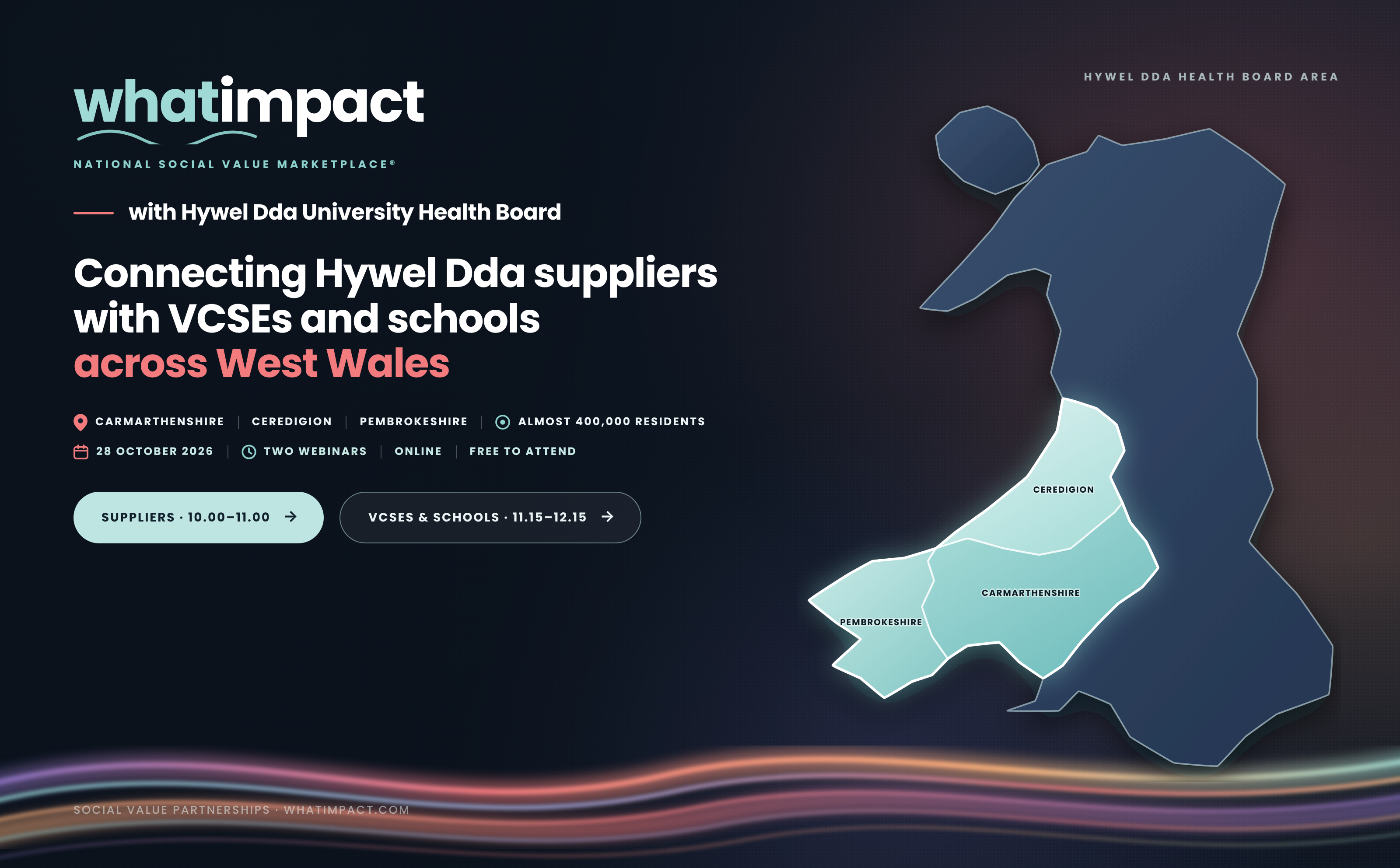
The health board serves almost 400,000 residents across Carmarthenshire, Ceredigion and Pembrokeshire. Its suppliers can now use the whatimpact National Social Value Marketplace® to find local charities, social enterprises, community groups and schools, build partnerships and evidence the impact they create, all in one place and to one standard, leaning on true impact data.
We believe this is the largest commitment of its kind by an NHS organisation to date. More importantly, it brings the buyer, suppliers and local organisations into one coordinated system, funded centrally by the health board.
What has Hywel Dda committed to?
Three decisions make this approach different.
One system for suppliers. Instead of each supplier finding partners and reporting separately, suppliers can use one system to plan, deliver and evidence their social value partnerships. Hywel Dda can coordinate activity across its supply chain rather than leaving every supplier to solve the same problem alone.
Hywel Dda pays for supplier access. Suppliers do not need to buy a licence or subscription. The health board has funded access across its supply chain.
VCSEs and schools always use whatimpact for free. There is no charge to join, find opportunities, build partnerships or complete impact reports.
This removes the financial barriers for everyone involved.
The NHS depends heavily on the voluntary sector
To understand why this matters, look at what happens outside hospitals and clinics.
People recovering from cancer may rely on charities for counselling, peer support, employment advice and practical help. Families managing long-term conditions may need support with housing, benefits or caring responsibilities. Hospices provide end-of-life care. Local organisations support mental health, tackle loneliness, provide food and warmth, help families in crisis and run activities that improve health and wellbeing.
These organisations form an important part of the wider health and wellbeing ecosystem, but much of their work depends on grants, donations and other external funding.
Public procurement creates another route for resources to reach them. Suppliers delivering public contracts are increasingly expected to create additional social value alongside their core contract.
Hywel Dda is putting a system behind that opportunity so these resources can be coordinated rather than distributed through disconnected, one-off activities.
What changes with one marketplace?
Normally, each supplier has to find suitable local partners itself. Who should they approach? Does the organisation match the contract commitments? Does it have capacity? How will delivery be managed and evidenced?
When this happens separately for every contract, the same work is repeated again and again.
With whatimpact, suppliers can publish what they can offer and local organisations can apply directly. VCSEs and schools register once and become visible to relevant suppliers across the health board’s supply chain.
This makes partnership building faster and gives organisations a more equal opportunity to be found, rather than relying on existing relationships.
Hywel Dda can also see activity across the system: what suppliers have committed, which partnerships have formed, what is being delivered and what impact is being created.
Bringing procurement and charitable funding together
Hywel Dda’s own health charity is also part of the ecosystem.
This creates an opportunity to see where supplier resources and charitable funding could complement each other. Instead of separate teams supporting similar projects without visibility of each other’s activity, resources can be better coordinated around local needs.
A supplier contribution might strengthen a project already receiving charitable funding. Several suppliers might support the same longer-term intervention. Duplication can be identified earlier.
This is where procurement-related social value and grant-making can begin to support the same communities more strategically.
Every partnership produces real impact evidence
Every completed partnership can generate a standardised qualitative impact report, completed by the organisation that delivered the work.
The report captures outcomes and indirect outcomes, real-life impact, key learning, testimonials, case studies, photographs and supporting evidence. It can also include local deprivation and area data to demonstrate the need behind the activity.
This moves reporting beyond simply counting money, donations or volunteering hours.
Hywel Dda can access the evidence across its supply chain, while suppliers receive credible reporting for their contract delivery. Because every report follows the same structure, information can also be aggregated and analysed across multiple partnerships. AI can then help identify patterns across the data, creating a wider picture of what the health board’s purchasing power is actually achieving across West Wales.
That is the difference between reporting activity and demonstrating impact. Wales already has a strong policy framework for long-term wellbeing and socially responsible procurement. Both the delivery of The Future Generations Act Goals and TOM Wales Measures are captured in whatimpact imapct reporting. Hywel Dda is putting facilitation infrastructure in place for bigger impact, more efficient social value.
It needs to work at every scale
A social value system needs to work for both smaller contracts and major procurement programmes. whatimpact brings together small community organisations, schools, regional VCSEs and larger national organisations within the same marketplace. This means suppliers can find partners appropriate to the size, location and objectives of their contracts.
The system supports social value across areas including employment and skills, health and wellbeing, equal opportunity and environmental outcomes. Most importantly, VCSEs and schools in Hywel Dda area get resources at scale, in continuous manner through varied contract work.
“This is where whatimpact – National Social Value Marketplace® Wales truly comes to life. We are launching this partnership with Hywel Dda, and we want to work with the rest of the Welsh health boards in the future.”
Tiia Sammallahti, CEO, whatimpact
JOIN OUR WEBINARS TO HEAR MORE:
✅ Supplier webinar – 28th Oct, 10am
✅ VCSE & school webinar – 28th Oct, 11.15am
whatimpact — National Social Value Marketplace®