Social value deserves a system: introducing the new whatimpact
Social value now helps decide who wins public contracts. Councils, NHS bodies and housing associations commonly give it 10% to 30% of the tender score. From January 2027, PPN 026 sets a minimum 10% weighting on relevant central government contracts from £1m, rising to 20% from £5m. For many suppliers, the social value response is no longer a box to tick. It can be the difference between winning and losing.
Yet in most businesses, social value still runs on spreadsheets, inboxes and goodwill. That gap between commercial importance and operational reality is what the new whatimpact is built to close.
A commercial function still running on spreadsheets
No business would run sales without a CRM, HR without an HR system, or marketing without automation tools. These functions drive growth, so they get purpose-built systems and professional processes.
Social value has earned the same status, but rarely gets the same investment. Social value and contract managers rebuild plans from scratch for every bid. They search for credible community partners one email at a time, and chase delivery updates across dozens of contracts. Then they assemble reports by hand when the client asks for evidence. The cost of all this manual work doesn’t disappear. It lands on the contract margin.
Leadership teams that treat social value as a key commercial success factor need to give it the tools that status deserves.
A CRM for social value
whatimpact is a holistic social value management system, and the simplest way to describe it is as a CRM for social value. It brings contract social value, community grant management and employee volunteering into one system. Every partnership, commitment and outcome is held in one place.
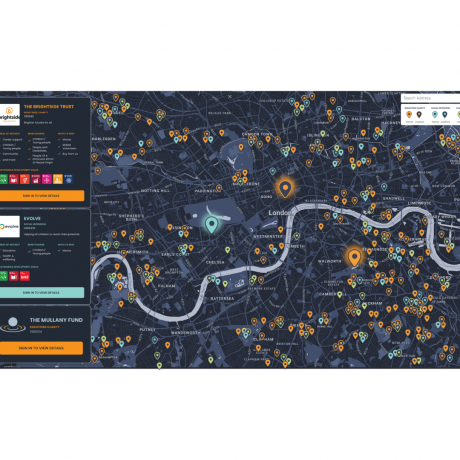
Behind it sits the National Social Value Marketplace®, with more than 300,000 VCSE profiles and 20,000 schools and colleges, built from official registers. Bid teams use it to build credible, partner-backed plans. Contract teams use it to deliver and report against each contract. Community, people and ESG teams use it for grants, volunteering and disclosure. Leadership sees the whole picture.
Every match and report is linked to the contract number, contracting authority and procurement framework. Your clients can see delivery as it happens, without anyone chasing.
Not all social value tools are the same
Social value calculators have their place, but they are bookkeeping. They put a proxy value on an activity. That isn’t evidence that the activity happened or that it changed anything, and on its own it no longer meets the reporting requirements clients expect.
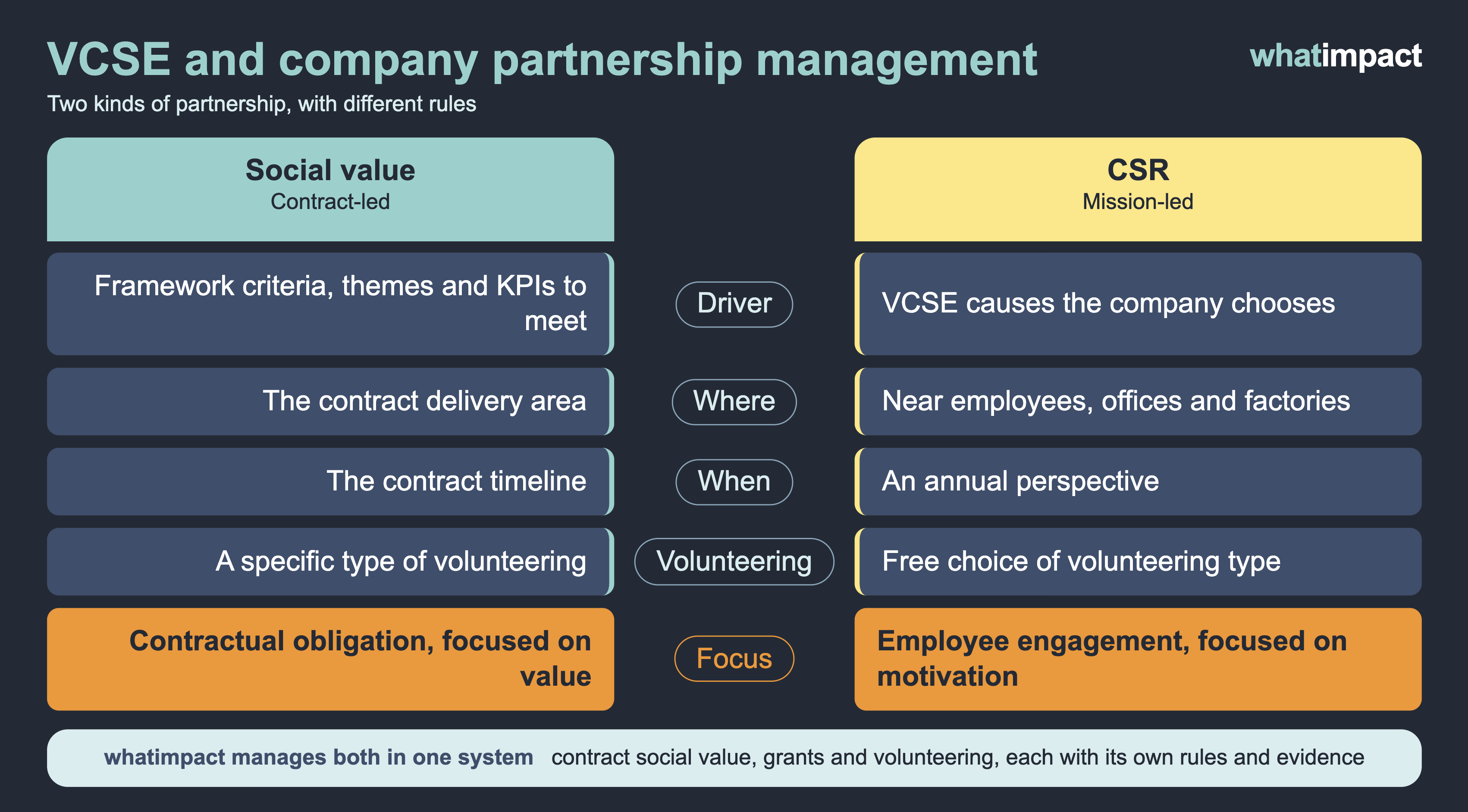
VCSE matchmaking tools vary just as widely. Some are simple directories limited to one geographic area. Others are designed mainly for CSR or grant-giving, where companies choose mission-driven causes near their own offices, plan annually, and let employees pick how they volunteer.
Contract social value works differently. It starts from framework criteria, themes and KPIs. It must be delivered in the contract area, within the contract timeline, often through a specific type of activity. It is a contractual obligation, judged on the value it delivers.
For a supplier managing tens or hundreds of contracts across the country, a tool built for CSR, or confined to one region, quickly stops being relevant. whatimpact was designed for that reality: nationwide, contract by contract, with evidence at every step.
Maximising the value of every pound and every hour
Social investment is real investment. Donations, gifts in kind, funded placements and employee time all carry a cost. The question for leadership is whether that investment works as hard as it could.
whatimpact helps it do so. Commitments are matched to the right local partners, so less effort is duplicated and less money is spread thinly across one-off gestures. Each activity produces evidence of what changed in the community. That evidence becomes a track record of verified delivery, which strengthens the next bid. Credible delivery wins work, and well-evidenced impact wins more of it.
Data your finance team, HMRC and auditors can rely on
Social investment also has a financial side that is too often overlooked. Some contributions, such as qualifying charitable donations and certain gifts to charities, may be eligible for tax relief. Claiming it depends on accurate records that finance teams can trust and that HMRC and auditors can verify. The same records support ESG disclosure, annual reporting and client reporting.
whatimpact doesn’t give tax advice. It gives your finance team and advisers a consistent, contract-linked record of social value data in four areas.
Qualitative, Verified Data To Back Any Montised Social Value Claims
Partnerships with VCSEs and schools. Each partnership produces a partner-verified Social Impact Report (SIR), written by the organisation that delivered the work. It covers inputs, outputs, outcomes, learnings and supporting evidence.
Environmental and sustainability activity. Suppliers record their environmental commitments in the contract work, and evidence to back it.
Employment in contracts. Suppliers capture contract specific jobs, apprenticeships, placements and training, and what kind of results and feedback they generated to those being part.
Supply chain data. Suppliers evidence spend and activity with SMEs, VCSEs and local businesses.
Our new Self-aAssessed reporting, launching soon, covers the last three areas. It follows the same internationally valid reporting method than VCSE partnership reporting. It is easy, and swift to use as we have mapped over 200 activities to choose from to report against. All outcomes can be tagged to the TOM System, TOM Wales, the GOV Social Value Model and the Wellbeing of Future Generations Act goals. Together with partner-verified SIRs, it gives one evidence base across everything your business delivers.
From administrators to success managers
The biggest gain isn’t the time saved. It’s what your people do with that time.
When matching, tracking and reporting run in a purpose-designed digital environment, social value and contract managers stop being administrators. They become success managers, working from real-life data. They can shape stronger bids and build long-term partnerships with community organisations. They can advise leadership on where investment creates the most impact, and give stakeholders reporting that stands up to scrutiny.
That is the shift from manual work to a professional social value function. Social value deserves to be managed with the same seriousness as sales, HR and marketing. The organisations that do it first will win the contracts, keep management costs down and show their impact with confidence.
Find out how whatimpact works for government suppliers: whatimpact.com/private-sector