From funding pot to measurable change: a smarter approach to outcome-led grant-making
Grant-making is often treated as an administrative process: publish a fund, receive applications, assess them, distribute the money and request reports at the end. But if a grant programme has a specific social outcome in mind, the more important question comes before the application form is ever published: What change are we actually trying to create, and why do we believe the activities we fund will create it?
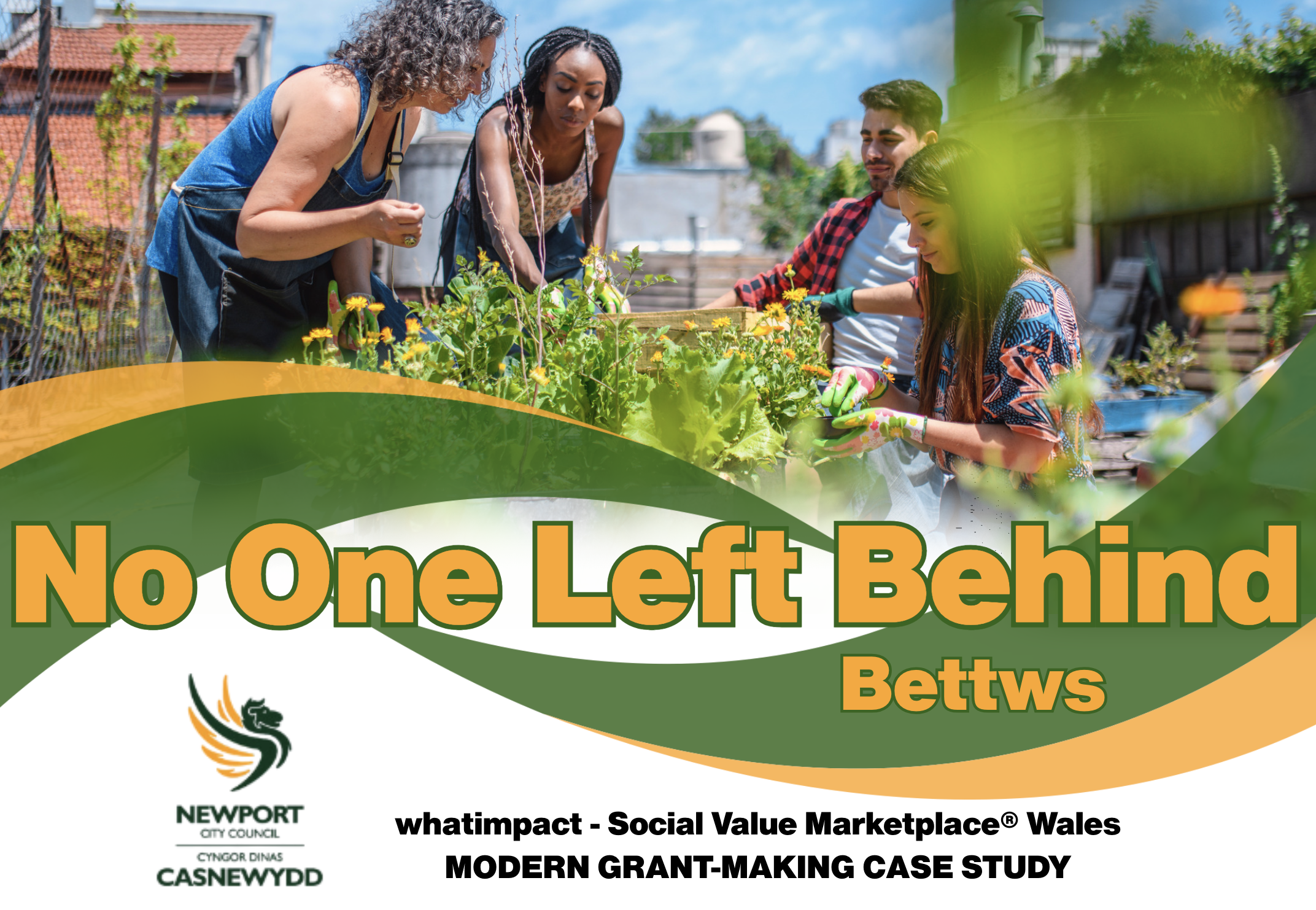
At whatimpact – National Social Value Marketplace®, we believe modern grant-making should combine social science, local knowledge, data, technology and impact measurement. Technology can then make that approach scalable without creating an impossible administrative burden for the funder or the organisations applying. Our work with Newport City Council provides a practical example. whatimpact technology has now supported the distribution and management of approximately £3.5 million through different grant programmes in Newport, including the targeted #NoOneLeftBehind programme.
Start with the problem, not the grant application
There is rarely one route to achieving a social outcome. Poverty is an obvious example. It is not a single problem with a single cause. Structural inequality, employment, education and skills, poor health, housing, transport, social exclusion, debt and the effects of living with long-term scarcity can interact in very different ways. Our research for #NoOneLeftBehind therefore examined several established ways of understanding poverty, including structural and human-capital theories, social exclusion, behavioural approaches and the capability approach. Each points towards different types of intervention.
This matters enormously when designing a grant programme. Are we funding immediate relief, such as helping a household experiencing food or fuel poverty? Are we looking for an outcome, such as improved skills, better mental health or increased access to employment? Or are we trying to achieve longer-term systemic change, reducing the likelihood that people and families remain in or return to poverty?
All three can be legitimate. But they are different objectives requiring different interventions, timescales, resources and measures of success. That is why an outcome-led grant programme needs a clear theory of change behind its funding decisions.
Combining theory with real local data
Theory alone is not enough. For #NoOneLeftBehind, our approach was to connect different theories of poverty with measurable socioeconomic indicators and then use those to understand the particular characteristics of the target area.
The research methodology considers income, education, employment, health, housing, safety and access to services together, before connecting patterns in that data with potential intervention approaches. It then proposes prioritising interventions according to factors including the number of people affected, severity of deprivation, strength of evidence, cost-effectiveness, feasibility and the expected time horizon of impact. This is important because two communities that both appear to have high levels of poverty may require very different solutions.
For example, low wages combined with poor transport access may point towards employment, transport and skills interventions. Poor educational attainment may require early-years, youth or adult-learning programmes. High levels of isolation may call for community infrastructure and participation. Multiple overlapping disadvantages may require a genuinely integrated intervention rather than another isolated project. Place-based funding should therefore mean more than drawing a boundary on a map. It should mean understanding the place before deciding what to fund.
Local organisations and residents need to be part of that intelligence
Data tells only part of the story. VCSE organisations, schools and other community organisations often understand the causes of local problems, gaps in provision and barriers experienced by residents in ways that cannot be captured through deprivation indices alone. For the Newport work, whatimpact developed a structured VCSE engagement approach covering local experience, the groups most affected by poverty, changing needs and geographical concentrations of deprivation.
Crucially, the consultation did not simply ask organisations what projects they wanted funded. It explored perceived root causes, barriers preventing residents from improving their circumstances, existing community assets, gaps in provision, potential early interventions and opportunities for collaboration. That distinction is important. Good grant-making should not simply fund the organisations that are best at responding to an application form. It should create a route for the organisations closest to the problem to contribute to understanding it.
The #NoOneLeftBehind model
Newport’s #NoOneLeftBehind programme provides an opportunity to put this approach into practice at a very local level. The first £500,000 programme has focused on Duffryn. The research underpinning the programme examined the wider Tredegar Park & Marshfield ward, with approximately 11,900 residents, and identified significant inequalities within Duffryn despite the area’s mixed socioeconomic profile. The evidence highlighted education, employment access, youth engagement and community capacity among the areas relevant to breaking cycles of deprivation. The research also identified persistent pockets of deprivation alongside educational underachievement, underemployment, health inequalities and limited community engagement.
This provides a much stronger starting point than simply announcing that £500,000 is available to “tackle poverty”. It creates a basis for deciding what the funding is expected to change.
Technology should widen access, not create another barrier
There is, however, a practical challenge. A funder may want an open and equitable process, but hundreds of poorly matched applications create a considerable administrative burden. The temptation can therefore be to restrict promotion or make application processes increasingly demanding. We believe technology with robust data and management rigor provides a better answer. The whatimpact marketplace allows grant opportunities to be promoted across a large ecosystem of VCSE organisations and schools while using structured organisational, geographical, beneficiary and project information to help reach organisations relevant to the programme.
The objective is not simply to generate more applications. It is to generate the right applications from a wider and more representative pool of organisations. A well-designed process can start with proportionate information and expressions of interest, rather than asking every organisation to spend days preparing a lengthy funding application. More detailed assessment can then be concentrated where it adds value.
At the same time, the technology coordinates applications, communications, assessment and scoring, decisions, agreements and acceptance documentation. This can dramatically reduce the manual management burden associated with running an open programme. That means equal opportunity and administrative efficiency do not have to be opposing objectives.
The grant award is the beginning of impact measurement, not the end of the process
One of the greatest weaknesses in traditional grant-making is the separation between awarding money and understanding what happened afterwards. The same theory of change that informed the grant criteria should continue into impact reporting. Projects funded through #NoOneLeftBehind are therefore reporting through whatimpact’s structured qualitative impact reporting system. Rather than reducing impact to a single financial proxy, reporting can capture the chain from inputs and outputs through to outcomes and wider or indirect outcomes, supported by evidence, learning, testimonials, case studies and photographs.
This is particularly important for complex social problems. A project may not take somebody permanently out of poverty within a short funding period. But it may improve school attendance, stabilise a family experiencing crisis, increase confidence, connect somebody to employment, reduce isolation or prevent a more serious intervention being required later. Those outcomes matter. By standardising the way this evidence is collected across funded projects, reports can subsequently be consolidated and analysed using AI to identify common outcomes, patterns, learning and emerging evidence across the programme. The result is not simply a folder containing dozens of unrelated final reports. It is programme-level intelligence.
Closing the loop
This is where technology can fundamentally change grant-making. A modern grant programme can create a continuous evidence cycle:
Understand local need → define the theory of change → engage communities → design targeted criteria → promote opportunities equitably → select appropriate interventions → manage delivery → collect standardised impact evidence → analyse collective outcomes → use the learning to improve the next funding round.
The Newport research explicitly follows this principle by connecting measurable deprivation indicators to theories of poverty and then to different intervention choices. That feedback loop is particularly valuable for recurring or place-based funding. Each round should make the next one better informed.
A new infrastructure for grant-making
Councils are not the only organisations that can benefit from this approach. Combined authorities, NHS organisations, housing associations, foundations, corporate funders and other grant-making organisations face many of the same challenges: how to reach the right organisations, provide equitable access, reduce administration, make defensible funding decisions and ultimately demonstrate what their investment achieved.
whatimpact brings these elements into one infrastructure: data and research, an established VCSE and school ecosystem, grant promotion and applications, assessment and administration, partnership management, and standardised impact reporting. The ambition is not simply to digitise the traditional grant application. It is to make grant-making more intelligent before the money is distributed, more efficient while programmes are being managed, and far more informative after the money has been spent. Because the ultimate measure of a successful grant programme is not how efficiently £500,000 was distributed. It is whether that £500,000 reached the right organisations, supported the right interventions and created the change it was intended to achieve.
Contact whatimpact.com to learn more how we can support modern grant-making!