The opportunity is real. The skill is knowing what AI does brilliantly, and what still belongs to people.
Artificial intelligence has arrived in procurement, and in social value its impact is already being felt. Bidders use large language models to shape their responses; commissioners are starting to use the same tools to read them. This is not a passing trend, and it is not something to resist. Used well, AI makes social value responses sharper, evaluation more consistent, and the whole process far less buried in paperwork. The opportunity is genuine and immediate. The skill worth learning now is simply this: knowing precisely what AI does brilliantly, and where human judgement remains essential. Get that balance right, and AI can be harnessed to the benefit of communities.
Start with what AI does brilliantly
A great deal. AI can take a human-written social value plan and map it against every part of the criteria, flagging the angle that has been missed or left under-developed. It can check that a proxy sheet and a written method statement actually support each other, rather than quietly telling two different stories. It can help a bidder pressure-test its own ambition: if a local delivery team of a hundred people is planning a hundred volunteering days a year, AI can prompt the honest follow-up about whether the track record is there to support it, given that organisations everywhere find it hard both to source opportunities and to free up staff time. That is not AI casting doubt; that is AI helping a bidder make a promise it can keep. On the evaluation side, with the right prompting, it brings welcome consistency, testing whether commitments are tangible and proportionate to the size and shape of the contract.
And yes, AI is fast and capable with proxy values — the monetary figures attached to social value activities. It can model every permutation, find the combination that scores well, and weigh it against the real cost to deliver in salaries, donations and time. For a bidder planning in good faith, that is a real gift: it turns hours of spreadsheet work into minutes.
Keep people in the lead where it matters
Here is the other half of the picture, and it is not a weakness — it is simply the right division of labour. Proxies measure spend, not change; they are inputs and outputs, and a higher number does not by itself mean a life improved. What turns a plan into impact lives in the method statement, and that is human territory. AI cannot know whether a commitment is genuinely deliverable. It cannot decide, on a company’s behalf, whether the budget and capability exist. And it cannot invent the things that make a plan real: a named partner, an agreed relationship, a specific project with specific beneficiaries, the systems to manage and report on delivery once the contract is live.
Those are facts about the real world, and they are exactly where people add the value AI never will. A strong method statement sets out how each commitment will be delivered — when, in which neighbourhoods, and with which partners. When those partners are VCSEs or schools, they should be named, the partnership genuinely agreed, the beneficiary project defined, and the reporting already in place. This is where AI and people do their best work together: the human brings the real plan and the real relationships; AI helps express it clearly and stress-test it. That partnership produces better answers than either could alone.
It still begins with the right question
AI amplifies whatever it is pointed at, which is why the contracting authority’s role is more important than ever, not less. The best results come when an authority is clear about where procurement can realistically make a difference — grounded in its own deprivation data, informed by residents and by the VCSEs and schools who serve them, and aligned with its corporate priorities and the National Procurement Policy Statement. Ask for genuine outcomes, and AI becomes a force multiplier for good practice, helping everyone plan, articulate and evidence real benefit.
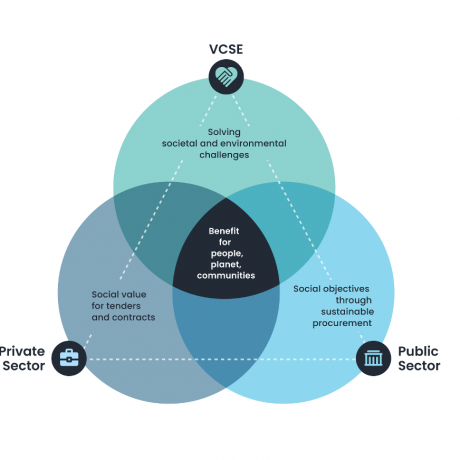
There is a bigger prize in view as well. Most voluntary and community organisations will never be government contractors, and most do not want to be; their strength is as social value delivery partners. The sector is stretched, and if authorities ask for and properly evaluate genuine partnership, hundreds of millions of pounds in donations, services, skills and volunteering could flow toward the organisations closest to the need. The main barrier has always been connectivity — bidders and communities unable to find one another — and that is precisely the kind of problem technology is built to solve. AI enhanced matching on the right tools can be powerful.
The right seat for a permanent guest
AI is here to stay in social value, and that is good news. The task is not to hold it back, but to give it the right job: alongside people, sharpening and checking their work, and freeing them to focus on the relationships and judgement that only people can bring. Used that way, AI makes the whole process more honest, more rigorous and more ambitious. Because impact itself has not changed — it is still a plan delivered to named people, in real places, by partners who were always going to show up. AI, in the right seat, simply helps us deliver it better.